How to Plan a Dinner Party Menu: A Practical Guide From First Course to Last

The dinner party menu is where most hosts lose the most time. You open a recipe website, favourite twelve things, close the tab, open a different one, and repeat. An hour later you have no menu and significantly more anxiety than when you started. The problem is not a shortage of good recipes — it is the absence of a framework for choosing between them.
A dinner party menu is not a collection of dishes you want to cook. It is a system: courses that complement each other, prep that distributes across the available time, and a flow that allows the host to be at the table rather than managing the kitchen. This guide gives you that framework, from the questions to ask before you start to the specific decisions that make a menu work as a whole.
Start With Constraints, Not Recipes
Before you look at a single recipe, answer four questions. The answers narrow the field dramatically and make every subsequent decision easier.
How many guests? Portion sizes, oven capacity, and the complexity of individual plating all depend on headcount. A menu that works beautifully for four can become logistically difficult at eight. For a dinner of eight or more, see [dinner party for 8](#) for the specific adjustments that guest count requires.
Are there any dietary restrictions? Collect this information before planning anything. One guest with a severe allergy, one vegetarian, or one person avoiding gluten changes which dishes are viable and which are not. It is far easier to build around a restriction from the start than to retrofit a menu after it is planned. For more on how to handle this gracefully, see [how to handle dietary restrictions at a dinner party](#).
How much cooking time do you have? A dinner party menu that requires six hours of active cooking on the day is a different proposition to one where 80% of the work is done the day before. Be honest about your available time — and your available energy. A make-ahead menu almost always produces a calmer evening than one built around last-minute cooking.
What is the occasion? A celebration dinner warrants more courses and more deliberate choices than a regular Saturday dinner with friends. The occasion also signals the right tone — formal, relaxed, festive — which should be legible in the menu before guests take their first bite.
The Three-Course Structure: Why It Works
A three-course menu — starter, main, dessert — is the most reliable structure for a home dinner party. It provides enough variety to feel like an occasion without the complexity of managing four or five separate courses in a home kitchen. It has a clear rhythm: something to settle guests in, something to anchor the evening, something to close it.
The instinct to add courses — a soup between the starter and main, a cheese course before dessert — is understandable, but each additional course adds prep, adds timing complexity, and extends an evening that may not need extending. Add a course when the occasion genuinely calls for it, not because more feels more impressive.
When a two-course menu is the right call: A relaxed dinner with close friends, a weeknight-adjacent gathering, or an evening where the main is genuinely substantial enough to carry the meal on its own. Two courses done well is always better than three courses where one of them is clearly padding.
When four or five courses makes sense: A formal celebration, a long Saturday dinner with guests who want to linger, or an occasion where the meal itself is the evening's entertainment rather than a backdrop to conversation.
How to Choose a Starter
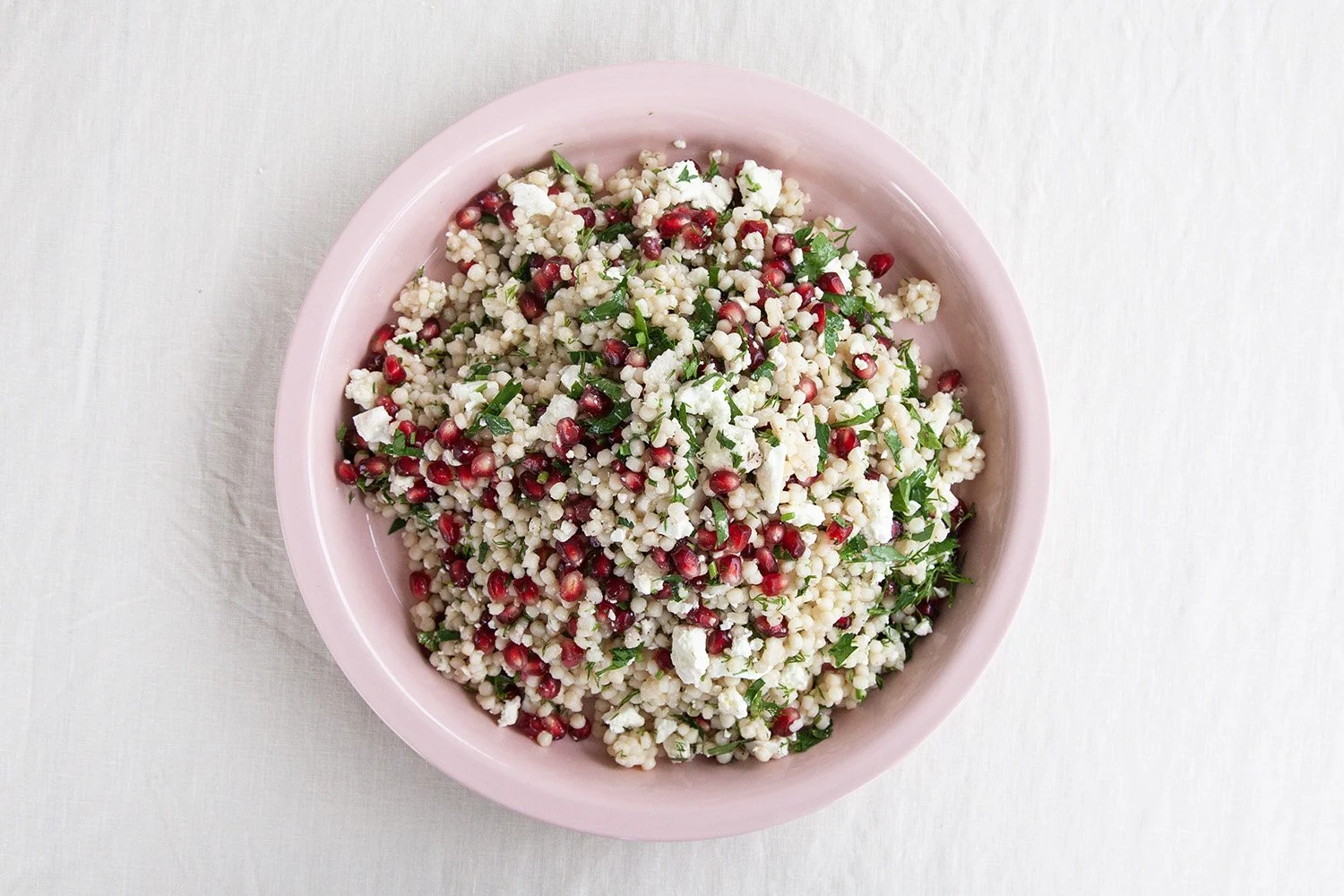
The starter sets the register for the rest of the meal. A heavy, rich starter puts guests in a different place than a light, fresh one — and that carries through to how they receive the main.
The starter should be lighter than the main. If the main is a slow-braised lamb shank in red wine sauce, the starter is not a rich pâté. It is a fresh salad, a light soup, or a simple assembled dish. If the main is a delicate piece of fish, the starter can do a little more work.
The starter should be almost entirely make-ahead. This is the practical requirement above all others. A starter that requires last-minute cooking keeps you in the kitchen while guests are in the room. A starter that can be plated in advance, or assembled in under five minutes, lets you be present from the moment everyone arrives.
Strong make-ahead starter options:
- Chilled soup poured and garnished just before serving
- A grazing board assembled in the afternoon
- Whipped dips with toasted bread or crudités
- A salad that is dressed at the table from pre-prepped components
- Individually plated dishes that can be done hours in advance and stored in the fridge
How to Choose a Main
The main course is the anchor of the dinner. It should be the dish you are most confident cooking, the one that suits your guest count and kitchen setup, and — ideally — the one that improves when made in advance.
Match the main to your kitchen's capability. A dish that requires multiple burners firing simultaneously at the exact right moment is a liability in a home kitchen at a dinner party. A slow-cooked braise that reheats gently while you talk to guests is an asset.
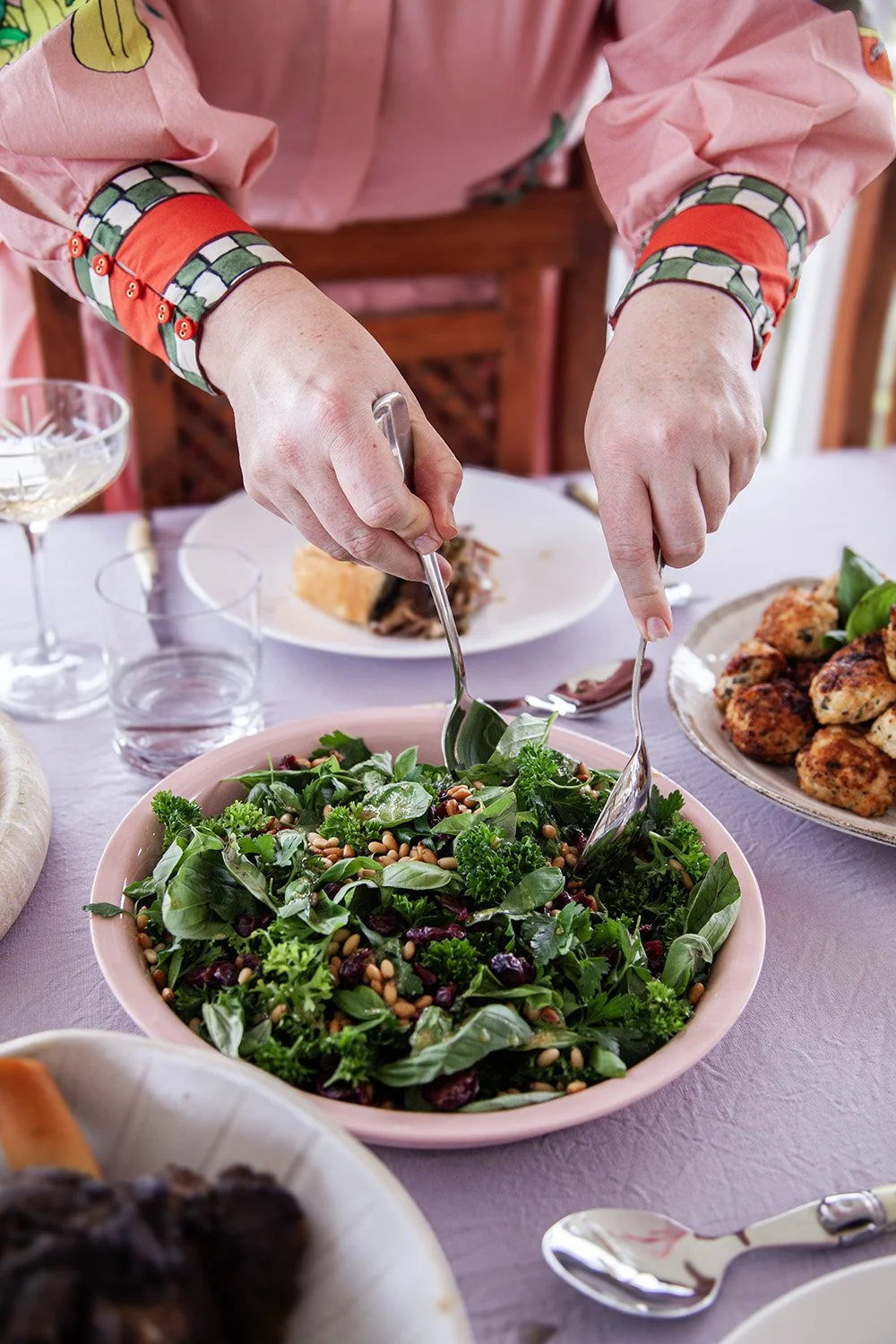
Serve family-style wherever possible. Large platters in the centre of the table, guests serving themselves, is the single most practical service decision a home entertainer can make. It suits the informal warmth of a home dinner, it removes the logistics of getting eight individually plated dishes to the table while hot, and it creates a generosity at the table that individual plating often does not.
Pair the main with sides that hold. Individually cooked, last-minute sides multiply the complexity of the main course window dramatically. Choose sides that can be made in advance and served at room temperature — grain salads, roasted vegetables, simple green salads dressed at the table — rather than ones that need attention at the same moment as the main.
For a curated set of main course options with make-ahead instructions, see the make-ahead dinner party menu guide.
How to Choose a Dessert
Dessert has three requirements: it should be made entirely in advance, it should provide contrast to the main course, and it should be clearly enough for everyone at the table.
Made entirely in advance means plated or assembled before guests arrive, or requiring only minimal finishing — adding cream, scattering fruit — at serving time. A dessert that requires active cooking after the main course is done puts you back in the kitchen when the evening should be winding down.
Contrast with the main means light after heavy, fresh after rich, cold after hot. A slow-braised main followed by a chocolate mousse works. A delicate fish main followed by a light panna cotta works. A rich main followed by an even richer dessert leaves guests feeling overloaded.
Clearly enough is not about extravagance — it is about not running out. A pavlova that can serve twelve when you have eight, a mousse that was made in a large batch, a tart that was cut into more slices than strictly necessary. Abundance at dessert feels generous. Careful portioning that runs short does not.

The Coherence Test
Before you commit to a menu, run it through the coherence test. Read through every course in sequence and ask:
Does the flavour profile make sense as a progression? A Mediterranean starter leading into an Asian-inspired main creates dissonance. It does not need to be a single cuisine — eclectic menus work — but there should be a logic to the sequence that guests can feel even if they cannot articulate it.
Is every dish trying to be the star? A menu where every course is complex, highly seasoned, or technically demanding exhausts guests and exhausts the host. One showpiece dish — usually the main — with simpler courses around it is the right balance.
Where does the oven and stovetop time conflict? Go through every dish and map when it needs heat. If three dishes need 180 degrees at the same time and you have one oven, the menu has a problem that needs solving now, not on the evening itself.
Could you cook this menu the day before? If the answer is mostly yes, the menu is well-structured. If the answer is mostly no, consider adjusting. The make-ahead dinner party menu guide is a useful reference for how to restructure dishes around advance cooking.
A Simple Framework for Building Your Menu
If you are starting from a blank page, this sequence takes the decision fatigue out of the process:
1. Choose the main course first — it is the anchor, and everything else is built around it
2. Choose a starter that is lighter in weight and easier to prepare than the main
3. Choose a dessert that contrasts with the main and can be made entirely in advance
4. Map the prep across the available days — what can be done two days before, what the day before, what on the morning
5. Write the shopping list dish by dish and split into two shops
If that process still feels like too much, The Dinner Party Guide handles all of it for you — a complete menu for the occasion, a shopping list, and a timed prep plan in a single downloadable resource. Browse the full collection to find the one that fits your next gathering.
Pick a date. Send the invitation.For guidance on how much wine to buy and what to serve with each course, see the dinner party wine pairing guide. For the full pre-dinner planning sequence, see the dinner party checklist.
Pick a date. Send the invitation.